
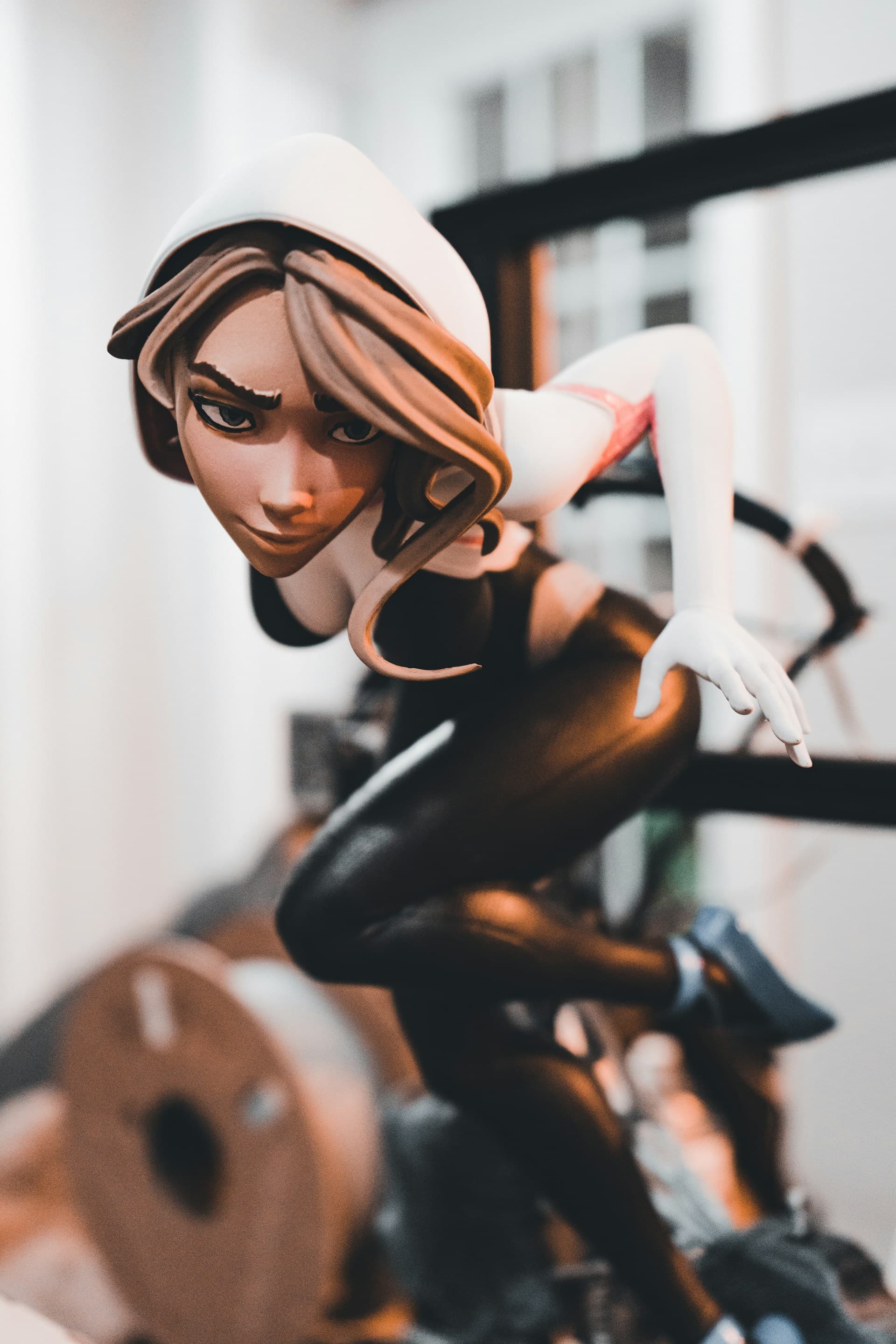
Why airbrush instead of a brush
A traditional paintbrush leaves visible strokes almost no matter how skilled the painter is, and on a small-scale miniature those strokes read as texture that shouldn't be there. Skin should look like skin, not like something with brush marks running across it. An airbrush atomizes paint into a fine mist and lays it down in thin, even layers with no stroke direction at all, which is the only realistic way to get smooth gradients on something the size of a hand.
It's also the only practical way to blend one color into another without a hard edge. Fading a jawline from a lighter highlight into a deeper shadow tone, or transitioning fabric from one color to another along a seam, requires control over exactly how much paint lands in a given spot, and that's a dial you adjust on an airbrush, not something a brush tip can reliably do at this scale.
What happens before any color goes on
Paint doesn't stick well to a raw print straight off the machine. FDM prints have visible layer lines and a slightly waxy surface from the filament itself, and resin prints, even after washing and curing, have a surface that's smoother but still not ideal for paint adhesion. Primer solves both problems. A thin, even coat of primer gives the surface a uniform texture and color that the actual paint can grip, and it's also the stage where flaws in the print, a rough support scar that wasn't fully sanded, a seam line, become visible and get fixed before they're locked in under paint.
We typically prime in a neutral gray or white depending on the final color scheme, gray when the piece will end up in darker tones overall, white when we're building toward lighter or more saturated colors. The choice affects how many color coats it takes to reach full opacity later, so it's not arbitrary.
Thinning, pressure, and why both matter
Airbrush paint almost never comes out of the bottle ready to spray. Most acrylics need thinning to somewhere around a milk-like consistency before they'll atomize properly through a fine nozzle, and getting that ratio wrong in either direction causes problems. Too thick and the airbrush sputters or clogs mid-pass. Too thin and the color goes on translucent, needing pass after pass to build any real opacity, which increases the risk of pooling in recessed detail.
Air pressure is the other half of the equation. We run lower pressure, generally in the range most detail airbrushes are tuned for, when working on faces and fine detail, since lower pressure gives finer control and a softer edge. Higher pressure moves more paint faster, which is useful for larger base coats but far too aggressive for something like painting individual eye detail on a piece a few inches tall.
The order we actually paint in
Painting a figure isn't one pass front to back. It happens in a sequence, and the sequence exists for a reason.
- Base coats first, establishing the overall color blocks for skin, clothing, and hair before any detail work starts
- Shadow work next, airbrushed into recesses and folds to build depth before highlights go on top
- Highlights after that, picking out raised edges and the points light would naturally catch
- Fine detail last, eyes, lips, small accessories, done under magnification once every larger layer has cured
Working out of that order almost always means redoing something. Highlight a raised edge before the shadow beneath it is set and the two blend into mud instead of reading as depth.
Sealing it so it survives being handled
The last stage is a clear coat, either matte or gloss depending on what the piece calls for. Skin usually gets a satin or matte finish because a glossy face tends to look plastic rather than lifelike under normal room lighting. Eyes, wet surfaces, or certain fabrics sometimes get a small amount of gloss specifically because that reflectivity is part of what makes them read correctly. The clear coat also does real protective work, guarding the paint job against fingerprints and the general handling a figurine picks up over years on a shelf.
Ventilation matters through this entire process, not as an afterthought. Airbrushing atomizes paint into particles small enough to stay suspended in air, and doing this work without a spray booth or proper extraction is a real exposure risk regardless of how safe the paint itself is once cured. Every painting station we run pulls air through a filtered booth for exactly that reason.
If you want to see the range of finishes this process can produce, our figurine options page compares our Air Spray Realism finish against a more classic acrylic look, and you can browse finished, painted examples on the reviews page.