
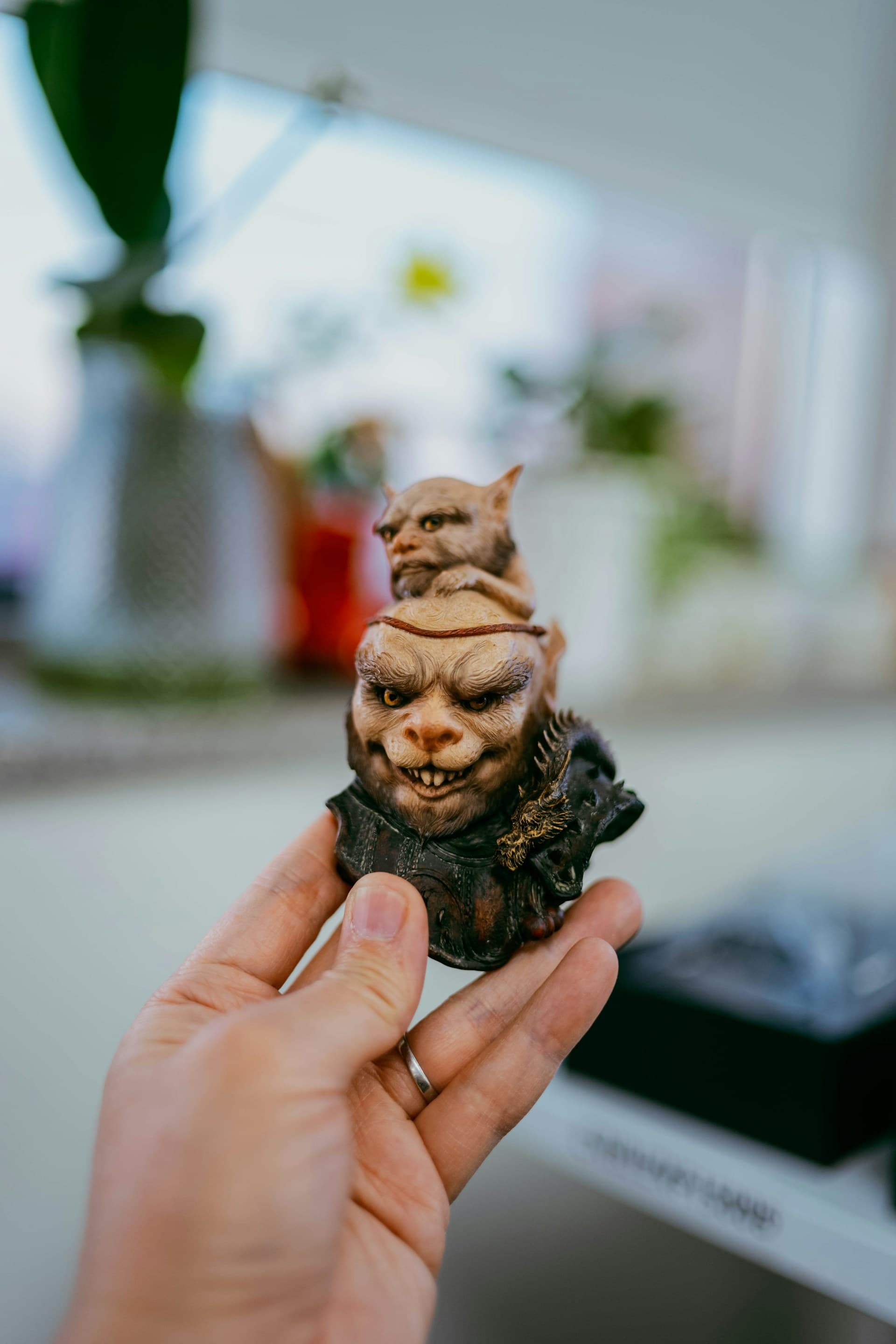
Faces are where people actually look
Send us a photo of someone in a full outfit, standing in an interesting pose, holding a prop, and we can tell you with near certainty which part of the finished figurine gets examined first when it arrives. It's the face. Not the shoes, not the fabric pattern, not even the pose. People know the face they sent us better than they know almost anything else about the photo, and that familiarity means the margin for error there is much smaller than it is anywhere else on the piece.
That's also why getting a face wrong is so noticeable even to someone who couldn't tell you exactly what's off. A jawline half a millimeter too narrow, eyes set slightly too close together, a brow angled a few degrees flatter than it should be, none of these are dramatic changes on paper, but the result reads as "close, but not quite them," which for a personal gift is often worse than being obviously wrong.
What a photo actually gives a sculptor to work with
A single two-dimensional photo is missing information a sculptor needs, specifically depth. How far the eyes are set back under the brow, how much the nose actually projects from the face, the true curve of a cheek in profile, none of that is directly visible in a front-facing photo. Our artists build that missing depth from experience with proportion and from any additional angles a customer sends, which is exactly why we ask for extra photos when someone has them available, even casual ones taken from the side or at a slight angle.
Skin tone adds a second layer of difficulty, because photos lie about color constantly depending on lighting. A photo taken under warm indoor light and one taken outdoors in shade can make the same person look like they have noticeably different skin tones, and a sculptor working purely from a photo has to judge which version is closer to reality. When we're not confident, we ask, rather than guess and risk a paint job that doesn't match.
Small details that carry disproportionate weight
- Eyebrow shape and thickness, which does more to convey a person's default expression than almost any other single feature
- The corners of the mouth, where a fraction of a millimeter of lift reads as a slight smile instead of a neutral expression
- Asymmetry, since real faces are never perfectly symmetric and a sculpt that's too even tends to look uncanny rather than accurate
That last point surprises people. The instinct when sculpting is to smooth things into symmetry, but a real face has a slightly higher eyebrow on one side, a nose with a barely perceptible lean, ears that sit at marginally different heights. Preserving a bit of that asymmetry, when it's visible in the source photo, is part of what makes a piece look like an actual person instead of a generic figure with their hairstyle.
Why the preview step exists specifically because of this
Every order gets a digital preview before anything is printed, and faces are the reason that step isn't optional. A sculptor can be skilled and still miss something the person who's known that face for years catches instantly. Maybe the smile reads as slightly smug instead of warm. Maybe the eyes look a touch too wide open, giving an expression of surprise that wasn't in the photo at all. These are subjective calls, and the person best positioned to catch them is whoever sent the photo, not the artist who's been staring at it for hours.
We build in unlimited revision rounds specifically because expression is this fiddly. Adjusting the angle of an eyebrow by a degree or two, softening a jawline, opening or narrowing the eyes slightly, these are quick changes for an artist to make once they know what to fix, and they're the difference between a figurine someone likes and one they actually love.
Where paint finishes what sculpting starts
A well-sculpted face still needs paint to fully read as an expression. Eyes in particular depend on paint almost as much as they depend on the underlying shape, a small white catchlight dot placed correctly makes a painted eye look alive, and skip it and even a well-sculpted eye looks flat and glassy. Lip color, the subtle blush of a cheek, the shading under a brow bone, all of it works together with the sculpted geometry rather than sitting on top of it as decoration.
If you're deciding between our two finish options, Air Spray Realism generally holds facial nuance better than a flatter acrylic finish does, since airbrushing allows the kind of soft gradient blending a face actually needs. You can compare both on our figurine options page, and see real finished faces from past orders on the reviews page.